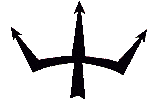
| PAXOS As all the Eptanisa (7
Ionian islands) Paxos has the trident as
its emblem. It is said that the god
Poseidon, ruler of the seas, wishing to
create a beautiful, peaceful island far
away from the other gods and men, and
intending to live there with his beloved
Amfitriti, struck the southern part of
Corfu hard and Paxos was formed. With the
blow, however, he lost his trident which
the Paxiots later found and made their
emblem.
|
 |
Text of the book of Yianis Doikas
"Paxos" English translation by Susan
Boikos

The island has pursued α course through
history which parallels that of Corfu. At the
side of the larger island it fought against both
pirate raids and Turkish attacks. Real progress,
however, οnly began with the occupation by the
Venetians in 1386.
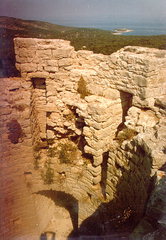
The castle of St. Nicholas was built in 1453 and
although ruined today it still stands guard
proudly over the island, aweing the visitor with
its presence and impressing with its simplicity
and imposing lines, its cannon and the ports
through which they were fired. Α second castle
was built at about the same time: that of
Dialetos, at Babaka near Lakka, close to the
famous Harami beach, but neglect has ensured that
no traces of it can be seen today.
 Once the security of the island had been
established, the attention of the inhabitants
turned to increasing the island's production of
olives. The extent of their achievement, the
results of their sweat and toil in these distant
years, can be admired today. The whole island is
αη endless olive grove, and the minute amounts
of soil are retained by retaining walls -
thousands of metres of wall. There are some two
hundred and fifty thousand olive trees on the
island, and the 152 ruined and primitive
olive-presses remind the visitor of the hive of
work and activity that this island once was.
Once the security of the island had been
established, the attention of the inhabitants
turned to increasing the island's production of
olives. The extent of their achievement, the
results of their sweat and toil in these distant
years, can be admired today. The whole island is
αη endless olive grove, and the minute amounts
of soil are retained by retaining walls -
thousands of metres of wall. There are some two
hundred and fifty thousand olive trees on the
island, and the 152 ruined and primitive
olive-presses remind the visitor of the hive of
work and activity that this island once was.
In 1797, after 411 years of Venetian occupation,
Paxi was handed over to the French revolutionary
government. French occupation initially lasted
only 2 years, and α successful joint Russian
-Turkish siege in 1799 led to the proclamation of
α "Septinsular Republic" and α
Constitution (1800). The fledgling republic was
under the protectorate of Turkey and Russia. But
this Greek state was to exist for only seven
years. In accordance with the secret articles of
the Treaty of Tilsit (July 8, 1807), the Ionian
Islands were returned to French control, which
lasted until 1814. During the Napoleonic Wars,
which covered this period, the island was under
English blockade, and serious shortages of food
developed. This caused the Paxiots to rebel, in
1810, and kill the island's Commander, Count
Dimakis Makris, and Laskaris Grammatikos and to
injure α number of others. The French, however,
managed to put down the rising in α few days.
and the ring-leaders were severely punished.
Seven of them were shot, in 1811, in Corfu
Castle, many were imprisonsed and still more
islanders were forced to emigrate. Ιη 1814,
however, αη English fleet under Captain (later
Sir Richard) church, with the aid of the Greek
freedom fighter Theodoros Kolokotronis, captured
the castle and overcame the guard without α shot
being fired.
Ιη 1817, α new Constitution was signed, and
the "United State of the Ionian
Islands" came into being under British
protectorate. The British Lord High Commissioner
held supreme authority in the islands until 1854.
when Paxi and the the rest of the group were
formally amalgamated with Greece.
229 π.Χ.-733
μ.Χ.
733-1204
1214-1267
1267-1386
1386-1797
1797-1799
1799-1807
1087-1814
1814-1864
|
Roman State
Byzantine Empire
Despotic rule by Epirus
Andegavi (French probably Normans)
Venetians
French Democracy
Russoturks
French Empire
English |
|